

A leaking kitchen sink cabinet is a very common problem in Malaysian homes, condos, rental units, wet kitchens, and shop lots. Sometimes you only see a few drops inside the cabinet. Sometimes the cabinet floor becomes wet, smells bad, or starts to swell.
Before calling a plumber or buying random parts, check where the water is coming from first. A kitchen sink leak underneath can come from the tap hose, sink waste, bottle trap, pipe joint, silicone seal, or even water splashing from above the sink.

1. First, Dry the Area and Find the Leak
Do not start removing parts immediately. First, clear the cabinet under the sink and wipe everything dry.
Then test one area at a time:
- Turn on the tap and let water run into the sink.
- Check the tap hoses and pipe joints.
- Fill the sink with some water, then release it.
- Check the sink waste, trap, and drain pipe.
- Splash a little water around the sink edge.
- Check whether water enters from the top, around the sink rim or silicone line.
This simple check helps you avoid buying the wrong part.
Simple rule:
If it leaks only when the tap is running, check the tap hose and supply pipe.
If it leaks only when water drains out, check the sink waste, trap, and drain pipe.
If it leaks after wiping or washing the countertop, check the silicone around the sink.
2. Common Leak Points Under a Kitchen Sink
| Where you see water | Common cause | What you may need |
|---|---|---|
| Water dripping from flexible hose | Old hose, loose nut, damaged washer | New flexible hose, washer, spanner |
| Water near tap base or countertop hole | Loose tap, worn tap seal, water entering from top | Tap tightening, seal replacement, plumber if needed |
| Water around sink waste | Loose sink waste, worn rubber gasket, poor fitting | Sink waste set, rubber gasket, plumber’s putty if suitable |
| Water from bottle trap or P-trap | Loose nut, cracked trap, missing washer | New trap, washer, hand tightening |
| Water from PVC pipe joint | Loose joint, poor seal, wrong pipe alignment | PVC fitting, PVC glue, replacement pipe |
| Water from sink edge | Old or mouldy silicone seal | Silicone remover, kitchen/bathroom silicone |
| Bad smell and slow water draining | Trap dirty, pipe partly blocked | Trap cleaning, drain cleaner, plumber if blockage is serious |

3. Check the Flexible Tap Hoses
Flexible tap hoses bring clean water from the wall valve to the kitchen tap. Most kitchen sinks have one or two hoses, depending on whether the tap has only cold water or both hot and cold water.
Check the hose carefully if water appears even when the sink is not draining.
Signs the Hose May Be the Problem
- Water dripping from the hose body
- Hose looks rusty or swollen
- Braided metal layer is damaged
- Water appears near the hose nut
- Hose bends too sharply
- Nut cannot tighten properly
If the hose body is cracked or swollen, replace the hose. Do not treat tape wrapped around the outside as a proper repair. It may help for a short emergency, but it is not a long-term fix.
What to Check Before Buying a New Flexible Hose
- Length – choose a hose long enough without forcing a sharp bend.
- Connection size – check both ends of the old hose before buying.
- Washer included – many leaks happen because the rubber washer is missing or damaged.
- Water type – check whether the hose is for normal cold water or hot water use.
- Space under sink – tight cabinets need hoses that can bend naturally without twisting.
4. Check the Sink Waste
The sink waste is the fitting at the bottom of the sink bowl where water flows out. It usually has a strainer basket at the top and a nut or connection underneath.
If water leaks from the centre bottom of the sink, the sink waste may be loose, badly fitted, or the rubber gasket may be worn.
Common Signs
- Water drips directly below the sink hole
- Water appears around the sink waste nut
- Sink waste moves when touched
- Rubber gasket is cracked, flattened, or missing
- Leak happens when you release a full sink of water
Sometimes the leak only appears when there is a lot of water draining at once. That is why filling the sink and releasing the water is a useful test.
Can You DIY This?
Some sink waste replacements are simple if the parts are standard and easy to access. But if the sink is old, the nut is stuck, or the pipe alignment is tight, it may be better to call a plumber.
Do not overtighten the sink waste. Too much force can damage the fitting, squeeze the gasket out of place, or crack plastic parts.
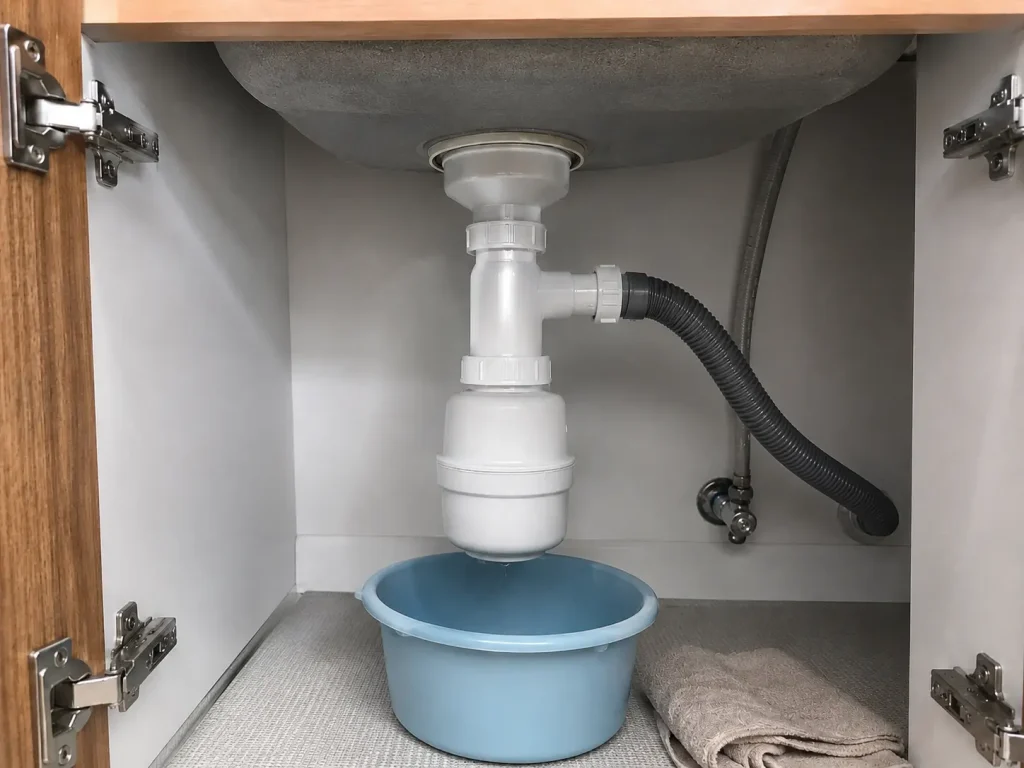
5. Check the Bottle Trap or P-Trap
The trap is the curved or bottle-shaped part below the sink. It holds some water inside to help block drain smell from coming back up.
Kitchen sinks commonly use:
- Bottle trap – compact and common under cabinets.
- P-trap – curved pipe shape, often used where there is more space.
- Flexible drain hose – used in some tight or budget installations, but it can trap grease and dirt more easily.
When the Trap May Be the Problem
- Water leaks from the trap nut
- Trap body is cracked
- Washer is missing or hardened
- Trap is not aligned straight
- Trap is dirty and water drains slowly
- Bad smell comes from the cabinet
For plastic traps, many connections are hand-tightened. You can try tightening gently by hand first. If it still leaks, remove the trap carefully, clean the washer area, and check whether the washer is damaged.
6. Check the Drain Pipe Joint
After the trap, water flows into the wall pipe or floor pipe. If the joint is loose, badly aligned, or not sealed properly, water can leak into the cabinet.
Check for:
- Water around the wall pipe opening
- Loose PVC pipe joint
- Pipe not inserted deeply enough
- Pipe pushed at an angle
- Old glue joint that has cracked
- Flexible hose that has slipped out
If the pipe joint uses PVC glue, it should be cleaned and glued properly. Thread tape is not for every plumbing joint. It is useful for some threaded connections, but it will not fix a loose push-in pipe or a badly aligned drain pipe.
If the wall pipe itself is cracked or leaking inside the wall, call a plumber or building maintenance.
7. Check the Silicone Around the Sink
Not all “under sink leaks” come from the plumbing below. Sometimes water enters from the top because the silicone around the sink edge has failed.
This is more common for top mount sinks and some flush mount sinks, because the sink edge sits at the countertop surface. When the kitchen counter is wiped often, the sink area is always wet, or old silicone has become black, loose, or mouldy, water can enter through the rim area and drip into the cabinet below.
For undermount sinks, this problem is usually less common because the sink is fixed below the countertop and there is no top rim sitting on the counter. But undermount sinks can still leak if the joint below the countertop, mounting clips, adhesive, or sealant has failed. If you see water near an undermount sink joint, check from below the counter instead of only checking the top surface.
Signs the Silicone Seal May Be the Problem
- Water appears after washing the countertop
- Cabinet is wet near the front or side edge
- Silicone line has gaps or cracks
- Silicone is peeling away from the sink
- Countertop near the sink feels swollen
- Leak does not happen when only draining water through the sink
If the silicone is the problem, remove the old loose silicone first. Do not simply apply new silicone over dirty or mouldy silicone. The new layer may not stick well.
For kitchen sink areas, choose a waterproof kitchen and bathroom silicone. Make sure the surface is clean and dry before applying.

8. Quick Troubleshooting Guide
| What happens | What to check first | Likely fix |
|---|---|---|
| Water leaks when tap is turned on | Flexible hose and tap connection | Tighten nut, replace washer, or replace hose |
| Water leaks when sink drains | Sink waste, trap, drain pipe | Tighten connection, replace gasket, replace trap |
| Water leaks after wiping counter | Silicone around sink edge | Remove old silicone and reseal |
| Cabinet smells bad | Trap water seal, dirty trap, pipe gap | Clean trap, check trap fitting, seal pipe gap |
| Water drains slowly and leaks | Blocked trap or drain pipe | Clean trap, clear blockage, call plumber if serious |
| Water comes from wall pipe area | Wall pipe or hidden joint | Call plumber or building maintenance |
9. Common Mistakes to Avoid
1. Buying a New Tap Before Checking the Hose
If water is dripping from the flexible hose or hose nut, the tap body may not be the problem. Check the hose and washer first.
2. Using Silicone to Fix Every Leak
Silicone is useful for sink edges and some gaps, but it is not the correct fix for a cracked trap, loose sink waste, or damaged hose.
3. Overtightening Plastic Parts
Plastic trap nuts and sink waste parts can crack if forced too much. Tighten firmly, but do not use excessive strength.
4. Ignoring Rubber Washers and Gaskets
Small rubber parts are very important. If the washer is missing, cracked, flattened, or not sitting flat, water can leak even when the nut is tight.
5. Forgetting to Check From Above the Sink
Water may enter from the countertop or sink rim, then drip underneath. Always check the silicone line and tap base.
6. Leaving Cabinet Leaks Too Long
A small kitchen sink leak can damage cabinet boards, create bad smell, attract insects, and cause mould. In condo units, serious leaks may also affect the unit below.
10. Parts and Tools That May Help
Depending on where the leak is, these items may be useful:
- Flexible tap hose for leaking, rusty, swollen, or damaged water supply hoses.
- Rubber washer or gasket set for small leaks at hose, trap, or sink waste connections.
- Sink waste set if the existing sink waste is loose, rusty, cracked, or missing parts.
- Bottle trap or P-trap if the trap is cracked, leaking, smelly, or hard to clean.
- PVC fittings and PVC glue for suitable drain pipe repairs.
- Thread tape for suitable threaded plumbing connections.
- Kitchen and bathroom silicone for resealing the sink edge.
- Silicone remover or scraper for removing old silicone before resealing.
- Aluminium under-sink cabinet protector for protecting the cabinet base from small leaks, spills, and water stains.
- Adjustable spanner for loosening and tightening nuts.
- Small pail and cloth for testing and cleaning under the sink.
An aluminium under-sink cabinet protector is useful if your sink cabinet base is made from plywood, MDF, or chipboard. It can help reduce the risk of swelling when small spills happen, but it should not be used to hide an active leak. Fix the leaking hose, trap, sink waste, pipe joint, or silicone first, then install the protector to help prevent future cabinet damage.

11. When Should You Call a Plumber?
Call a plumber or building maintenance if:
- Water is leaking from inside the wall
- The wall pipe is cracked
- The main valve cannot shut off water
- The sink waste is stuck and cannot be removed
- The leak keeps coming back after changing washers
- The cabinet is badly wet or mouldy
- Water is dripping to the unit below
- You are not sure which pipe carries clean water and which pipe carries waste water
For small leaks at the hose, washer, trap nut, or silicone line, many homeowners can check first before calling a plumber. But if the leak is hidden, serious, or connected to the wall pipe, do not force it.
Simple Buying Guide Before Ordering Parts
Before buying kitchen sink repair parts online, take clear photos and measurements.
Check:
- Where exactly the water comes from
- Whether the leak happens during water supply, drainage, or countertop washing
- Hose length and connection size
- Trap type and pipe diameter
- Sink waste size
- Whether the part is plastic, stainless steel, or brass
- Whether the cabinet space is tight
- Whether the cabinet base needs an aluminium protector after the leak is fixed
- Whether the existing part is cracked, loose, rusty, or only missing a washer
If the old part looks different from the product photo, do not guess. Measure first and compare the connection points.
Related Products to Consider
For a kitchen sink leak underneath, these categories may help:
- Kitchen repair parts
- Plumbing repair parts
- Flexible hoses
- Sink waste and strainers
- Bottle traps and sink traps
- Rubber washers and gaskets
- Thread tape and PVC glue
- Kitchen and bathroom silicone
- Aluminium under-sink cabinet protector
- Basic plumbing tools
- Sink leakage check kit
Not sure which part to buy? Dry the cabinet, test where the water appears, and take a clear photo of the leaking area. If the part size or connection looks different, send the photo and measurement before ordering so you can choose the correct item.