

A door that cannot close properly can be annoying, noisy, and sometimes unsafe. You may need to lift the door before it shuts, push it hard until the latch catches, or pull it because the bottom rubs against the floor.
Do not buy a new lock or hinge immediately. The problem may be as simple as a loose screw, a misaligned strike plate, paint buildup, or a wooden door that has swollen during wet weather.
First, check exactly where the door is touching or failing to catch. This will help you choose the correct fix and avoid changing parts that are still usable.

1. Close the Door Slowly and Watch What Happens
Open the door, then close it slowly without forcing it. Look at the gap between the door and the frame.
Check these areas:
- Top corner near the handle
- Top corner near the hinges
- Side edge near the latch
- Bottom of the door
- Floor, tiles, or threshold below the door
- Latch and strike plate
The latch is the small moving part that comes out from the door lock. The strike plate is the metal plate on the door frame that receives the latch.
You can also look for:
- Fresh scratch marks
- Chipped paint
- Shiny rubbing marks
- Loose hinge movement
- Uneven gaps around the door
- A latch that hits above or below the strike plate hole
Simple rule:
If the door rubs near the top, check the hinges first.
If it closes but will not stay shut, check the latch and strike plate.
If it rubs along a large area, check for swelling, warping, or frame movement.

2. Quick Troubleshooting Guide
| What happens | Common cause | What to check first |
|---|---|---|
| Door drops and rubs near the top or handle side | Loose hinge screws or worn hinge | Tighten the hinge screws |
| Door rubs against the floor | Loose hinge, swollen door, raised flooring, or door too low | Check hinge movement and bottom clearance |
| Door closes but latch does not catch | Strike plate or latch is misaligned | Check where the latch hits the plate |
| Door needs a hard push to close | Swollen timber, thick paint, rubber seal, or frame alignment | Find the exact rubbing point |
| Door opens by itself | Door or frame is not level | Check with a spirit level |
| Handle turns but latch does not move properly | Loose or damaged lockset | Tighten the handle screws and test the latch |
| Door suddenly becomes difficult during rainy weather | Wooden door or frame has absorbed moisture | Check for swelling, leaks, and damp areas |
| Gap around the door is very uneven | Door, hinge, or frame may be warped or shifted | Check all hinges and frame condition |
3. Problem: Loose Hinge Screws
Loose hinge screws are one of the most common reasons a door drops out of alignment. When the top hinge becomes loose, the handle side of the door may sag and rub against the frame or floor.
How to Check
Open the door halfway and support its weight. Gently lift the handle side.
If you see movement around the hinge or screws, the hinge may be loose.
Simple Fix
- Support the door so its weight is not pulling on the hinge.
- Tighten each hinge screw with the correct screwdriver.
- Start with the top hinge.
- Close the door slowly and test the gap again.
Use the correct screwdriver size. A driver that is too small can damage the screw head.
Do not overtighten. If the screw keeps turning without becoming tight, the screw hole may be stripped.

4. Problem: Stripped or Damaged Screw Holes
A stripped screw hole means the screw can no longer grip the timber properly. This often happens after the screw has been removed many times, overtightened, or installed into soft or damaged wood.
Signs of a Stripped Hole
- Screw keeps spinning
- Screw falls out easily
- Hinge pulls away from the frame
- Door drops again soon after tightening
Possible Fixes
For a timber door or frame, the hole may need:
- A slightly longer screw that can grip solid timber behind the damaged area
- A wooden dowel and wood glue to rebuild the hole before drilling again
- A hinge repair plate if the timber around the hinge is badly damaged
Do not use a longer screw without checking what is behind the frame. Hidden wiring, pipes, glass panels, or metal frames may be nearby.
For aluminium or metal frames, use the correct screw or repair method for that material. A normal wood screw may not hold properly.
If the timber is soft, wet, cracked, or damaged by termites, replacing the screw alone will not solve the problem. The frame or damaged timber may need repair.
5. Problem: Bent, Worn, or Wrong Door Hinge
A hinge may need replacement if it is bent, badly rusted, cracked, or loose around the hinge pin. Heavy doors can also sag if the hinges are too small or not strong enough for the door weight.
Check Before Buying a New Hinge
Measure and compare:
- Hinge length and width
- Hinge leaf thickness
- Number and position of screw holes
- Hinge pin type
- Door material and weight
- Frame material
- Indoor, bathroom, or outdoor location
For a bathroom, balcony, or other damp area, choose a hinge material or finish with suitable corrosion resistance.
Do not assume every door hinge is the same size. Bring the old hinge or take clear front, side, and screw-hole photos before buying.
For heavy solid timber, metal, glass, or fire-rated doors, use hinges approved for that door type and weight. Do not replace them with light-duty hinges just because the size looks similar.
6. Problem: Latch and Strike Plate Do Not Line Up
If the door can reach the frame but will not stay closed, the latch may be hitting the edge of the strike plate instead of entering the hole.
How to Check
Close the door slowly and watch where the latch touches the strike plate.
You may see:
- Scratch marks above the strike plate hole
- Scratch marks below the hole
- Latch hitting the front edge of the plate
- Plate moving because its screws are loose
Simple Fix
- Tighten the strike plate screws.
- Check and tighten the door hinges before moving the plate.
- Test the door again.
- If the latch is still slightly misaligned, loosen and reposition the strike plate carefully.
Only move the strike plate after checking the hinges. If a loose hinge caused the door to sag, moving the strike plate may hide the real problem instead of fixing it.
Do not remove too much timber from the frame. A badly enlarged strike plate hole can weaken the latch area and reduce security.

7. Problem: Sticky or Damaged Latch
Sometimes the door alignment is acceptable, but the latch does not move smoothly.
Check whether:
- The handle or knob screws are loose
- The latch stays inside when the handle is released
- The latch feels rough or jammed
- The lock body is rusty
- Paint or dirt is blocking the latch opening
First, tighten the visible handle or lock screws. Clean away dust and dried paint around the latch.
If lubrication is allowed by the lock manufacturer, use a small amount of suitable lock or hardware lubricant. Do not pour cooking oil or thick grease into the lock. It can collect dust and make the mechanism sticky.
Replace the latch or lockset if the internal part is broken, badly worn, or cannot spring back properly.
Before buying a new lockset, check:
- Door thickness
- Backset measurement
- Existing hole size
- Latch faceplate shape and size
- Handle or knob type
- Whether the door opens left or right, if the product requires it
8. Problem: Wooden Door Has Swollen
Wooden doors and frames can absorb moisture, especially during rainy periods or in bathrooms, wet kitchens, balconies, and poorly ventilated rooms.
A swollen door may:
- Become difficult to close during wet weather
- Rub along a wide section of the frame
- Feel tight at the top, side, or bottom
- Show peeling paint, damp marks, or mould
What to Do First
- Check for roof, wall, bathroom, or pipe leaks.
- Improve ventilation and allow the door to dry.
- Check whether the edges were properly painted or sealed.
- Test the door again after the moisture problem is controlled.
Do not immediately cut or sand a large amount from the door. When the timber dries, the gap may become too wide.
For a small and stable rubbing point, light sanding or planing may help. Seal and repaint the exposed timber afterwards so it does not absorb moisture easily.
If the door is badly swollen, soft, cracked, or rotten, ask a carpenter to inspect it.
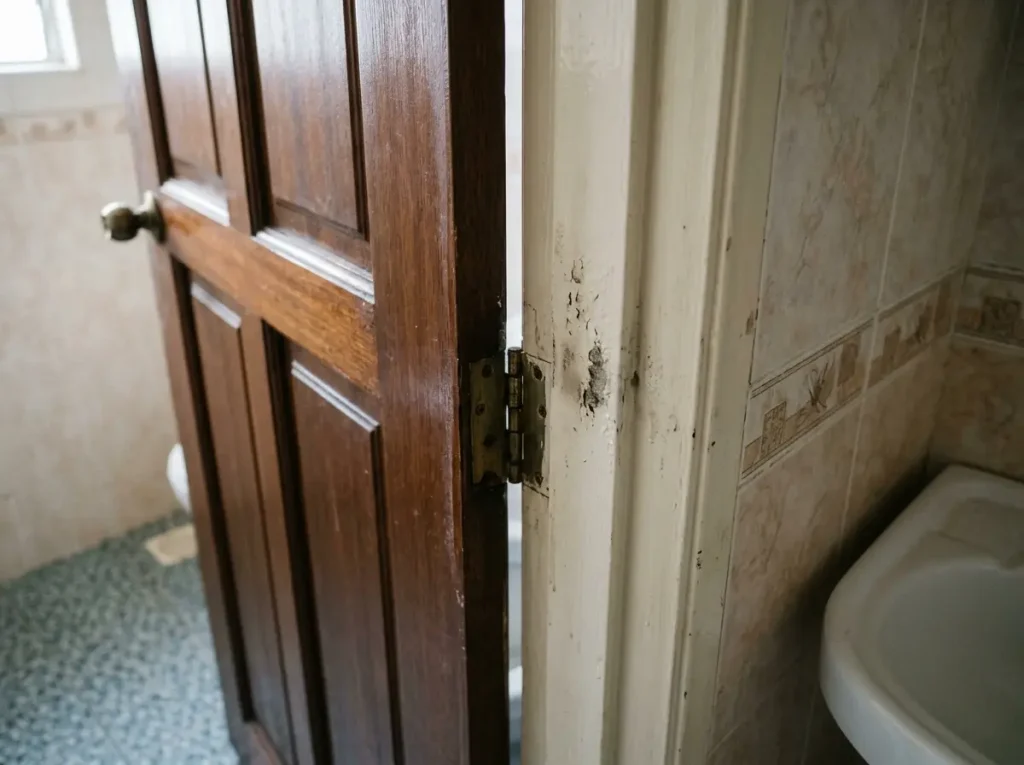
9. Problem: Paint, Rubber Seal, or Dirt Is Blocking the Door
Sometimes the hardware is fine. The door cannot close because something has reduced the gap.
Check for:
- Thick layers of paint on the door edge or frame
- New rubber weather seal that is too thick
- Loose door seal
- Dirt or small stones at the threshold
- A raised screw head
- A loose floor strip
- A door stopper or object blocking the swing
Remove the obstruction and test the door again. If a new rubber seal is too thick, replace it with the correct profile and size instead of forcing the door shut.
For metal security doors, check whether the rubber stopper, magnet, closer, or locking points are correctly aligned.
10. Problem: Door or Frame Is Warped
A warped door is no longer flat. A warped frame may also pull the door opening out of shape.
Possible causes include:
- Long-term moisture exposure
- Heat and direct sunlight
- Poor installation
- Building movement
- Impact damage
- Rotten or termite-damaged timber
You may see a large uneven gap, one corner sticking out, or several rubbing points at the same time.
Small hinge adjustments may not solve a badly warped door or frame. A carpenter may need to straighten, repair, or replace the affected part.
If several doors in the same home suddenly become difficult to close, or you also see new wall cracks, ask a contractor or building management to check for frame or building movement.
11. Tools and Parts That May Help
Depending on the cause, these items may be useful:
- Correct-size Phillips or flat-head screwdriver
- Screwdriver bit set
- Measuring tape
- Spirit level
- Replacement hinge screws
- Door hinges
- Wooden dowel and wood glue for suitable timber screw-hole repairs
- Hinge repair plate
- Strike plate
- Door latch or lockset
- Suitable lock or hardware lubricant
- Sandpaper and paint for a small, stable rubbing edge
- Door seal or weather strip in the correct thickness
Do not buy every item first. Find the cause, measure the existing part, and replace only what is damaged or unsuitable.

12. Common Mistakes to Avoid
1. Replacing the Lock Before Checking the Hinges
A sagging door can make the latch miss the strike plate. Tighten and inspect the hinges first.
2. Forcing the Door Shut
Repeatedly slamming or kicking the door can damage the lock, hinge screws, frame, tiles, or door surface.
3. Moving the Strike Plate Too Early
If the real problem is a loose hinge, the door may continue to drop after you move the plate.
4. Using the Wrong Screws
Screws must suit the hinge, door material, frame material, and required length. A screw that is too short or too thin may loosen again.
5. Sanding a Swollen Door Before Fixing the Moisture
The door may swell again if the leak or damp condition continues. Find the water source first.
6. Ignoring Rotten or Termite-Damaged Timber
New screws cannot grip properly in weak timber. The damaged area needs proper repair.
7. Changing Fire-Door Hardware Without Checking
Fire-rated doors use tested hinges, closers, latches, seals, and other parts. Do not drill, cut, plane, or replace hardware with ordinary parts unless the repair method is approved.
13. When Should You Call a Carpenter, Locksmith, or Building Maintenance?
Ask for professional help if:
- The door is very heavy or difficult to support safely
- The door or frame is badly warped
- The timber is rotten, wet, cracked, or termite-damaged
- The frame has moved away from the wall
- The lock is jammed and the room cannot be secured
- A metal security door has several misaligned locking points
- The door contains glass
- It is a fire-rated door
- The problem may be caused by building movement
- You are not sure whether hidden wiring or pipes are behind the frame
For rental units, check with the landlord or property manager before cutting the door, drilling new holes, or changing the lock.
Simple Buying Guide Before Ordering Door Hardware
Take clear photos and measurements before buying replacement parts.
Check:
- Where the door rubs or fails to latch
- Door material: timber, aluminium, metal, glass, or composite
- Frame material
- Door thickness
- Hinge length, width, thickness, and screw-hole positions
- Existing screw size and condition
- Strike plate shape and measurements
- Lock backset and existing hole size
- Indoor, bathroom, outdoor, or main-door use
- Whether the door is heavy, security-rated, or fire-rated
If the replacement part looks different from the old one, do not guess. A small difference in size or screw-hole position can make installation difficult.
Related Products to Consider
Depending on the problem, these product categories may help:
- Door hinges
- Hinge screws and suitable fasteners
- Hinge repair plates
- Strike plates
- Door latches and locksets
- Screwdrivers and screwdriver bits
- Measuring tapes and spirit levels
- Wood glue and wooden dowels
- Door seals and weather strips
- Lock and hardware lubricant
- Sandpaper, primer, and paint
- Door repair tool kits
For the most common problem, start with a screwdriver and check the top hinge. A loose hinge screw costs much less to fix than replacing the whole lock or door.
Final Recommendation
When a door cannot close properly, do not force it and do not replace parts at random.
Use this simple check:
- Door has dropped: check the hinges and screws.
- Door closes but does not latch: check the strike plate and latch.
- Door becomes tight during wet weather: check for swelling and moisture.
- Door rubs in several places: check for warping or frame movement.
- Lock mechanism feels stuck: check the handle, latch, and lockset.
Start with the simplest check, but stop if the door is heavy, badly damaged, fire-rated, or unsafe to support.
Not sure which hinge, screw, latch, or strike plate to buy? Take a clear photo of the full door, the problem area, and the existing hardware. Measure the part before ordering so you can choose the correct replacement.