

That orange streak down your gate wasn’t there last monsoon season. Now there are three more, the paint is bubbling where the metal underneath is corroding, and every time it rains — it spreads a little further.
In Malaysia — where humidity rarely drops below 80% and afternoon rain arrives most days — rust on iron gates and window grilles isn’t a sign of neglect. It’s what happens to unprotected metal in an equatorial climate. The good news: surface rust is completely reversible, and even deeper corrosion is manageable if you catch it early. This guide walks you through diagnosing the damage, treating what’s already there, and protecting your metalwork so you’re not doing this again in six months.
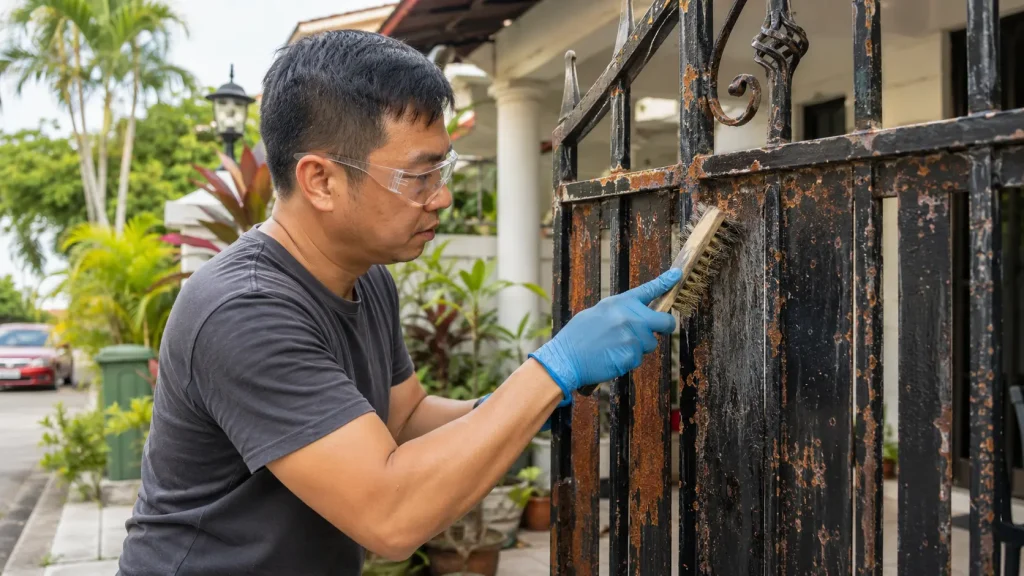
Phase 1: Why Malaysian Gates and Grilles Rust Faster Than You’d Expect
Most residential gates and window grilles in Malaysia are made from mild steel or wrought iron — metals that corrode quickly when oxygen and moisture meet. In Malaysia’s equatorial climate, that chemical reaction never really stops.
The Climate Factors Working Against You
- Constant humidity — Even on dry days, ambient humidity above 70% keeps surface moisture active. Rust doesn’t dry out between rain events the way it might in a drier climate.
- Daily monsoon rain — Water gets into paint joints, welded seams, and bolt holes — exactly where corrosion starts and hides.
- Salt air near the coast — If you live near the sea in Penang island, Port Dickson, or coastal Johor Bahru, airborne salt accelerates electrochemical corrosion dramatically.
- Heat cycling — Day-to-night temperature swings cause metal to expand and contract, cracking paint coatings and opening micro-fractures for moisture to enter.
Add to this that most gates get painted once at installation and never touched again — and you have ideal conditions for rust to establish and spread quietly for years before it becomes obvious.
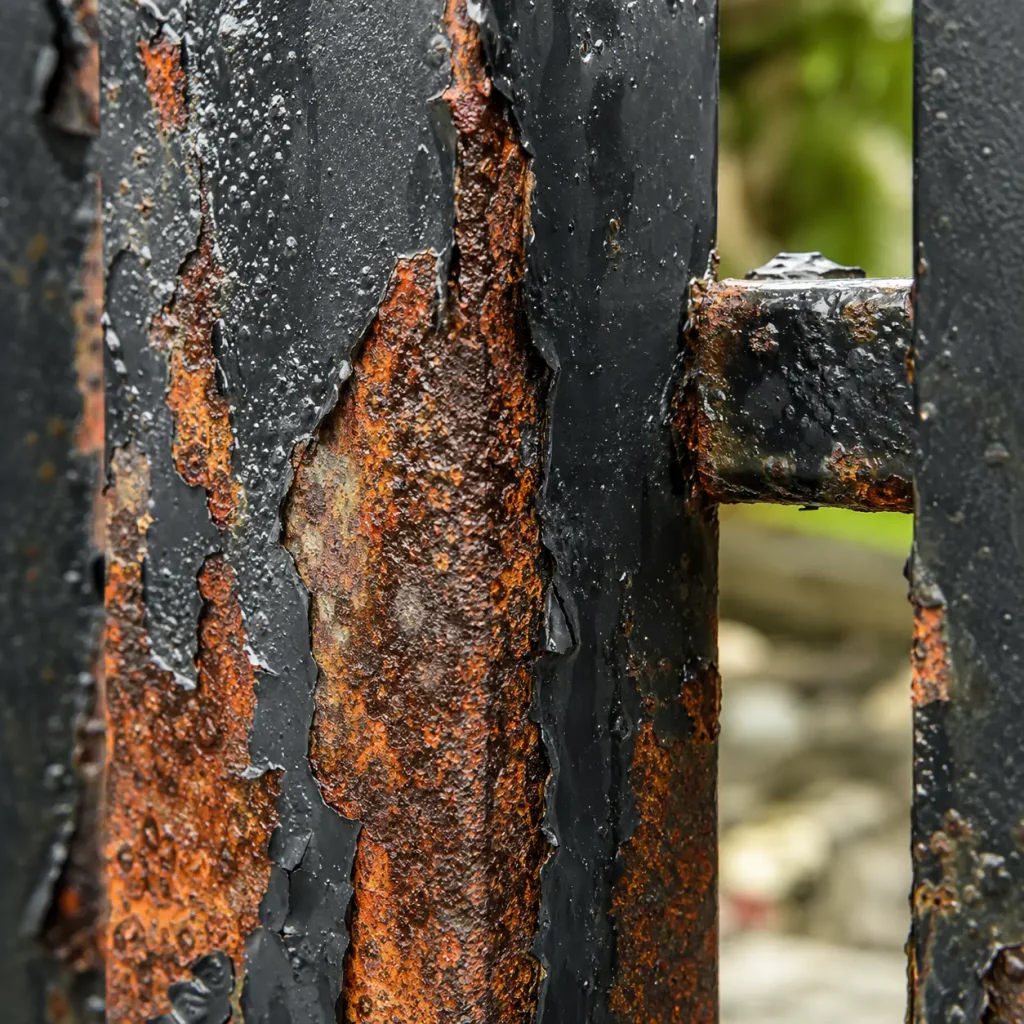
Phase 2: Diagnosing How Bad the Rust Actually Is
Before you buy anything or pick up a wire brush, assess what you’re dealing with. Treatment varies significantly depending on how deep the rust has gone.
Run the Rust Assessment
| Condition | What It Looks Like | Your Move |
|---|---|---|
| Surface rust | Orange-brown staining, paint bubbling or flaking. Metal still solid underneath. | Clean, treat, repaint. Full DIY. |
| Deep rust (pitting) | Rust has eaten into the surface — visible pits or roughness when you run your hand across it. | Wire brush, sand, rust converter, repaint. DIY with more effort. |
| Through-rust | Metal is visibly thin, crumbling, or has holes. Structural integrity is compromised. | Welding repair needed. Call a tukang las. |
The majority of residential gates and grilles in Malaysia fall into the surface rust or mild pitting category — both are fixable with the process below.
Also check these specific spots before moving on:
- Welded joints and corners — rust almost always starts here first
- Hinge and bolt areas — high-friction points where paint wears off fastest
- Anywhere two metal sections overlap — water pools in these crevices and sits
Phase 3: What You Need Before You Start
Tools and Materials Checklist
Gather everything before you begin. Stopping mid-treatment to run to the hardware shop lets moisture back in before the rust converter or primer has cured properly.
For rust removal:
- Wire brush — manual for small areas, drill attachment for larger gates
- Coarse sandpaper, 60–80 grit — for levelling pitting after wire brushing
- Fine sandpaper, 150–180 grit — for final smoothing before primer
- Rags and mineral spirits or acetone — for degreasing the surface before priming
For priming and painting:
- Rust converter (phosphoric acid-based — Rust-Oleum Rust Reformer or equivalent from your local kedai besi)
- Zinc-rich metal primer or anti-rust primer — not wall primer, not any primer
- Outdoor enamel or alkyd metal topcoat paint
- 2″ paintbrush for flat surfaces, small detail brush for joints and decorative scrollwork
- Masking tape and drop cloth to protect the floor and surrounding surfaces
Optional but useful:
- WD-40 or penetrating oil for seized hinges and locks
- Spray lacquer for decorative grille sections
- Safety glasses and nitrile gloves
Estimated budget: RM60–RM150 depending on gate size and whether you already own brushes and drop cloths. All items are available at your local hardware shop or on Shopee.
Phase 4: Removing the Rust — Step by Step
Step 1: Clean the Surface Thoroughly
Wash the gate or grille with water and a stiff brush to remove dirt, dust, and any debris packed into the joints. Let the surface dry completely — minimum 2–3 hours, or leave it overnight if you’re washing in the afternoon.
Painting over a damp or dirty surface is the single most common reason DIY rust treatments fail within months. This step is not optional.
Step 2: Remove Loose Rust and Flaking Paint
Use your wire brush to scrub away all loose rust and flaking paint. Work along the grain of the metal, not against it. Pay particular attention to:
- Welded joints and corners
- Hinge mounts and bolt points
- Areas where two metal sections overlap
You don’t need to remove every trace of rust at this stage — the rust converter (Step 4) handles residual rust chemically. What you must remove is anything that’s loose, flaking, or bubbling. Paint that isn’t bonded to the metal will cause the entire new paint system to fail.
Step 3: Sand the Surface Smooth
After wire brushing, sand with 60–80 grit coarse sandpaper to level pitting and rough edges. Follow with 150–180 grit to create a smooth profile the primer can key into.
Wipe down with a rag dampened in mineral spirits or acetone. This removes sanding dust and any grease from handling — both will prevent primer from bonding.
Step 4: Apply Rust Converter
Rust converter is a phosphoric acid-based treatment that reacts with iron oxide — rust — and converts it into a stable black compound that can be painted over. It neutralises active corrosion without requiring you to grind down to bare metal everywhere.
- Brush it directly onto all rusted areas
- Watch for the black colour change — that’s the reaction working as it should
- Allow to cure fully — minimum 1–2 hours for light surface rust, overnight for heavy or pitted areas
Important: Rust converter is not a primer. It stabilises rust and prepares the surface — but you still need primer before painting.
Step 5: Prime with Zinc-Rich Metal Primer
This is the step most Malaysian homeowners skip, and it’s why their treated gate looks orange again within a year.
For outdoor metalwork in Malaysia’s climate, use a zinc-rich primer or anti-rust metal primer. Zinc acts as a sacrificial barrier — it corrodes preferentially, protecting the steel underneath. Standard interior wall primer provides no meaningful protection on outdoor metal.
- Apply two thin coats, allowing each coat to dry fully before the next
- Work primer into joints, welds, and cut edges — these are the highest-risk points for new rust
- Don’t rush drying time — primer that isn’t fully cured before topcoat traps moisture underneath the paint system
Step 6: Apply Your Topcoat Paint
Use an oil-based enamel or alkyd paint rated for outdoor metalwork. These cure harder and resist moisture better than water-based emulsions — which aren’t suitable for iron gates exposed to Malaysia’s rain and humidity.
- Apply 2–3 thin coats rather than one thick coat — thick paint sags on vertical surfaces and cracks earlier
- Work from top to bottom on vertical bars so drips can be caught and brushed out before they set
- For decorative scrollwork and lattice grilles, use a small detail brush to work paint into inner curves — a roller will miss the recessed faces
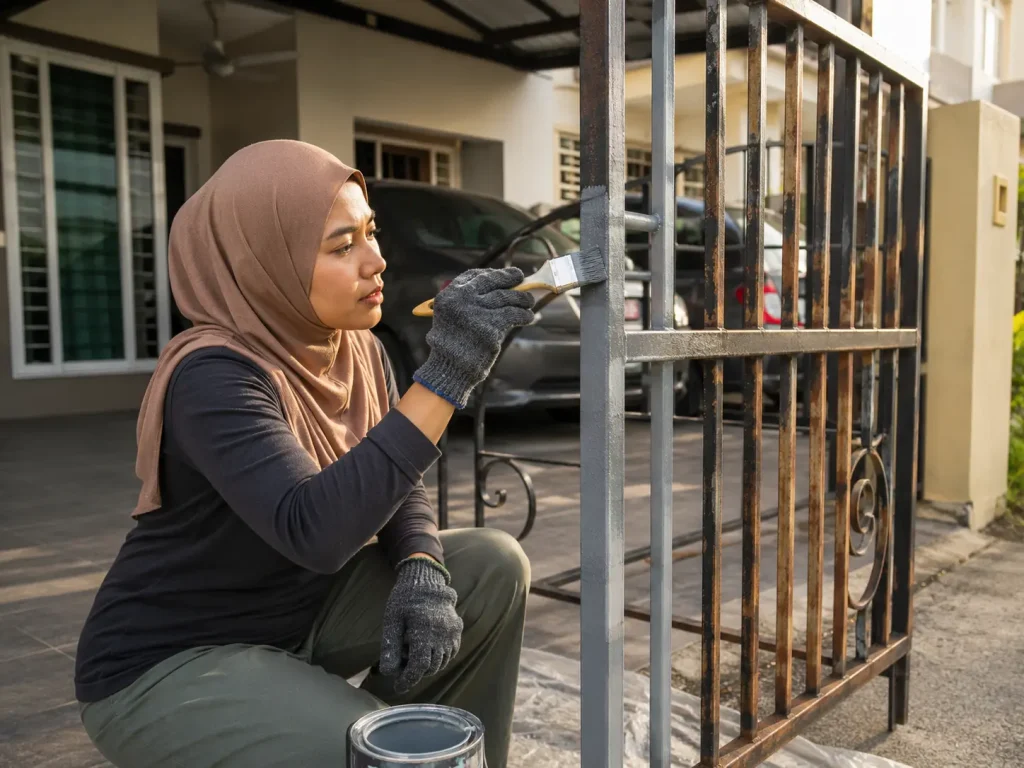
Phase 5: Preventing Gate Rust from Coming Back
Treating the rust is half the job. The other half is making sure you’re not back here doing this again in twelve months.
Build a Maintenance Schedule
Rust prevention in Malaysia’s climate is about catching problems before they become treatments:
- Inspect your gate every 6 months — look for bubbling paint, chips, or bare metal showing through
- Touch up any exposed spots immediately with primer and matching topcoat — don’t wait for the next full repaint cycle
- Plan a full repaint every 3–5 years — street-facing gates in full sun and rain need more frequent attention than sheltered carport gates
Apply Clear Lacquer to Decorative Grilles
Ornamental window grilles with detailed scrollwork are difficult to repaint neatly once rust starts eating into the detail. After your base coat of metal paint, apply one or two coats of outdoor clear lacquer over the top. This adds an additional moisture barrier and extends time between repaints — without changing the appearance of the metalwork.
Treat Hinges and Locks Separately
Gate hinges and padlock mechanisms seize up independently of the gate body — and a seized hinge puts stress on the entire frame and welded joints.
- Spray with WD-40 or penetrating lubricant, wait 15–30 minutes, then work the mechanism back and forth to loosen it
- Wipe off excess WD-40 once loosened — it evaporates and doesn’t provide long-term lubrication
- Apply white lithium grease or silicone spray as the permanent lubricant — both handle outdoor humidity well
- A gate hinge that won’t move at all needs replacing. A standard residential gate hinge costs RM8–RM30 depending on size
Inspect Welded Joints After Each Monsoon Season
Welds are where two pieces of metal meet — and there’s almost always a tiny crevice where rainwater pools and sits between events. After each monsoon season (roughly November and February), run a wire brush over all welded joints and touch up any bare spots before they spread.
Quick Product Reference
| Product | What It Does | Where to Buy |
|---|---|---|
| Rust converter (Rust-Oleum or equivalent) | Converts active rust to stable compound | Shopee, kedai besi |
| Zinc-rich metal primer | Anti-rust barrier before topcoat | Paint shop, hardware shop |
| Hammerite Metal Paint | Direct-to-rust paint — primer not required for light rust | ACE Hardware, Shopee |
| Outdoor enamel metal paint | Hard, moisture-resistant topcoat for ironwork | Hardware shop, Nippon Paint dealer |
| White lithium grease | Long-lasting outdoor hinge and lock lubricant | Auto shop, Shopee |
| Wire brush drill attachment | Faster rust removal on large gate surfaces | Shopee, hardware shop |
Note on Hammerite: It’s marketed as a paint-direct-on-rust system with no primer needed. It performs well for light surface rust on smaller areas. For badly corroded gates or long-term durability in coastal locations, the full treatment — rust converter + zinc primer + topcoat — gives significantly better results.
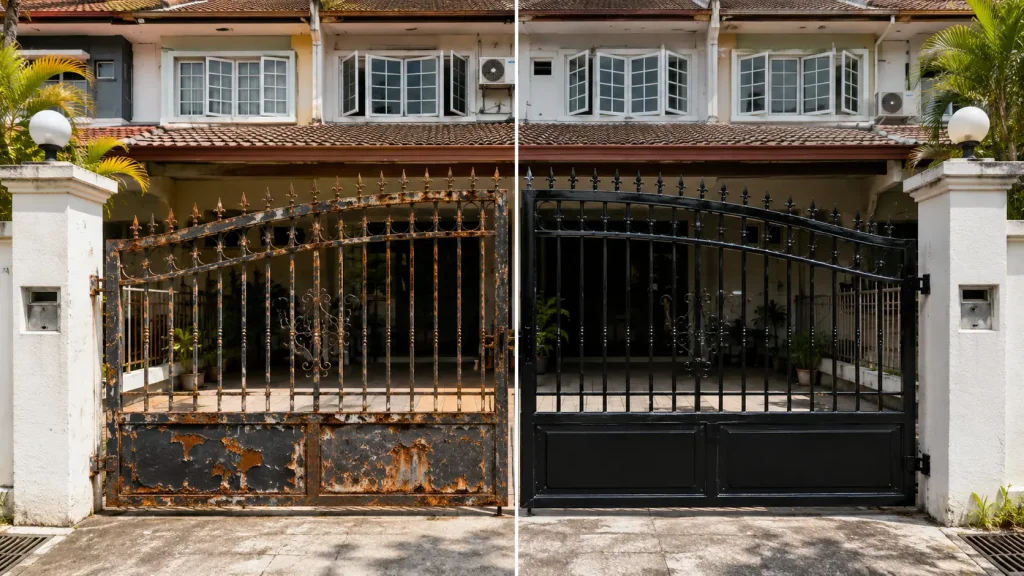
Final Thoughts: A Treated Gate Lasts — a Neglected One Doesn’t
Rust on a Malaysian gate almost always looks worse than it is. Wire brush it, convert it, prime it properly, and paint it — and you’re looking at five to eight years before the next full treatment. The key variable is the primer. Every homeowner who skips the zinc primer because it’s “just a gate” ends up retreating it within a year.
The same principle applies across all exterior metalwork at your property — window grilles, staircase rails, decorative ironwork around the porch. The more exposed to Malaysia’s rain and humidity, the more non-negotiable proper surface preparation becomes.
If you’re planning a broader exterior refresh or home maintenance project, Rumaruma has guides to help you work through it systematically — so nothing gets missed and nothing needs redoing in twelve months.
Treat the rust now, prime it right, and your gate will outlast the neighbours’ by a decade.